Introduction to the Magnificent Himalayas
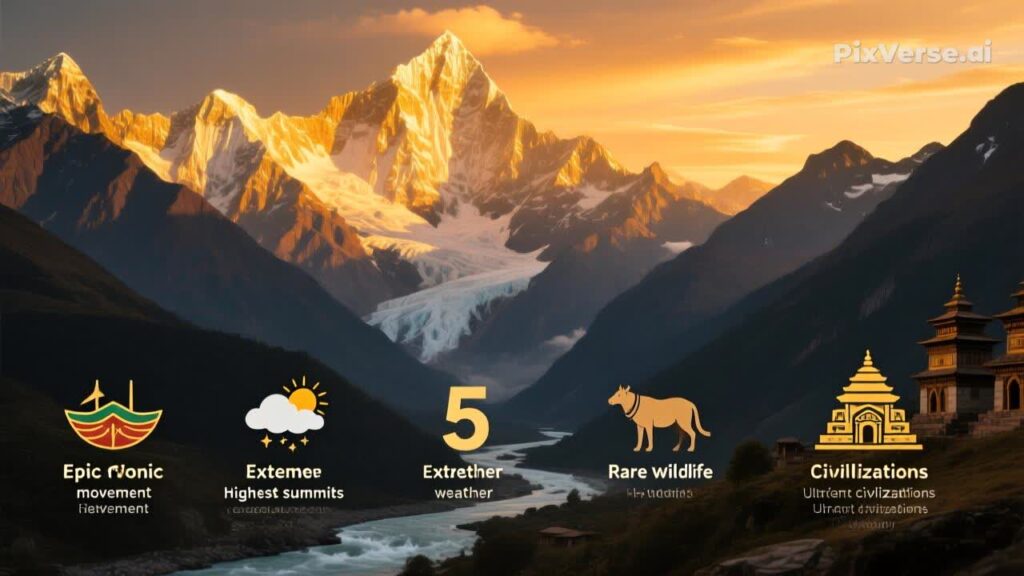
The Himalayan Mountains are one of the most awe-inspiring natural wonders on Earth. Stretching across five countries and towering above the clouds, they’ve captured human curiosity for centuries. But beyond their breathtaking beauty, the Himalayas hold countless secrets and phenomena that shape our planet. Here are 5 facts about the Himalayan Mountains: they were formed by tectonic plate collisions, contain the world’s highest peaks, influence global climate, host rare wildlife, and span five countries.
Why the Himalayas Matter
Imagine a giant wall of rock that influences weather, supports millions of people, and holds spiritual meaning for entire cultures—that’s the Himalayas. They’re not just mountains; they’re a living, evolving system with global significance.
A Quick Overview of the Mountain Range
Spanning roughly 2,400 kilometers (1,500 miles), the Himalayas cover parts of India, Nepal, Bhutan, China, and Pakistan. They include more than 100 peaks rising above 7,000 meters. From glaciers to deep valleys, the landscape is as diverse as it is dramatic.
Fact 1 – The Himalayas Are Home to the World’s Highest Peaks
Mount Everest and Other Giants
One of the most well-known facts is that the Himalayas host Mount Everest, the highest peak on Earth at 8,848.86 meters. But Everest is just one of many giants. Peaks like Kangchenjunga, Lhotse, and Makalu dominate the skyline with towering heights.
How These Peaks Formed
Millions of years ago, the Indian and Eurasian tectonic plates collided. Think of it like two massive cars crashing into each other, except in slow motion over millions of years. The force pushed the land upward, forming the Himalayas.
Ongoing Growth of the Mountains
Here’s the wild part—the Himalayas are still growing! The same tectonic activity continues today, causing the mountains to rise a few millimeters each year.
Fact 2 – The Himalayas Influence Global Climate
A Natural Weather Barrier
The Himalayas act like a colossal shield, blocking cold winds from Central Asia. Without them, the Indian subcontinent would have much harsher winters.
Impact on the Monsoon System
They also play a major role in the South Asian monsoon. When moist air from the Indian Ocean hits the mountains, it rises and cools, resulting in heavy rainfall— essential for agriculture.
Effects on Surrounding Regions
This climate-shaping power extends beyond South Asia. The Himalayas influence weather patterns as far away as China and Southeast Asia.
Fact 3 – The Himalayan Region Is Rich in Biodiversity
Unique Plant Life
From lush rhododendron forests to alpine meadows, the Himalayas support unique vegetation found nowhere else. Altitude changes create diverse ecosystems within short distances.
Diverse Wildlife Species
Snow leopards, red pandas, Himalayan tahrs, and countless bird species call this region home. Many are adapted to extreme cold, steep cliffs, and high altitudes.
Endangered Animals of the Himalayas
Sadly, species like the snow leopard and Himalayan wolf face threats from habitat loss and climate change. Conservation efforts are crucial to their survival.
Fact 4 – The Himalayas Hold Cultural and Spiritual Significance
Sacred Sites in the Mountains
For millions, the Himalayas aren’t just mountains—they’re sacred. Mount Kailash, for instance, is revered in Hinduism, Buddhism, Jainism, and Bon.
Cultural Diversity Around the Range
People living in the Himalayan region include Sherpas, Ladakhis, Tibetans, and many more. Each group has its own language, rituals, and rich heritage.
Traditions and Beliefs of Local Communities
From high-altitude festivals to monasteries perched on cliffs, the cultural landscape is as remarkable as the physical one. Many traditions revolve around nature and spiritual harmony.
Fact 5 – The Himalayas Provide Essential Water Resources
Origin of Major Rivers
Some of Asia’s most important rivers, including the Ganges, Brahmaputra, and Indus, begin in the Himalayas. These rivers sustain life across vast regions.
Water for Millions
The rivers and glaciers supply freshwater to more than a billion people. Without the Himalayas, many communities would struggle to survive.
Environmental Challenges
Climate change is melting Himalayan glaciers faster than ever. This threatens water supplies, increases the risk of floods, and impacts agriculture downstream.
Conclusion
The Himalayan Mountains are far more than a dramatic backdrop—they’re a vital part of Earth’s natural system. From towering peaks to sacred landscapes and life-sustaining rivers, the Himalayas play an irreplaceable role in shaping weather, culture, and ecosystems. Understanding these five key facts helps us appreciate not just the beauty of the mountains, but their global importance. Follow our LinkedIn page.
FAQs
Q Why are the Himalayas still growing?
A Because the Indian and Eurasian tectonic plates continue to collide, pushing the mountains higher.
Q What makes the Himalayas unique?
A Their massive size, biodiversity, cultural significance, and ongoing geological activity set them apart.
Q How old are the Himalayas?
A They began forming about 50 million years ago—geologically young compared to other mountain ranges.
Q Can you visit any Himalayan countries easily?
A Yes! Popular destinations include Nepal, Bhutan, and northern India, each offering stunning landscapes.
Q Are the Himalayas dangerous?
A They can be due to avalanches, altitude sickness, and harsh weather—so preparation is key.